 Breed
BreedTwo ebooks, each covering ten breeds. Pick yours.


Researched with real breed data
Written for owners, not for veterinarians
Instant PDF download
The Dog Breed Guide
Ten dog breeds in one ebook. Find yours, then use its routine table, its vet questions and its first-year section.
A 159-page PDF on genetics, health and daily care for ten breeds: French Bulldog, Labrador Retriever, Golden Retriever, German Shepherd, Beagle, Poodle, Rottweiler, Dachshund, Bulldog and German Shorthaired Pointer.
If you own, or are planning to get, one of these ten breeds, the book is written for you.
Each breed has its own chapter with a routine table (Normal / Vet visit / Vet now), breed-specific vet questions (3 to 5 per breed) and a first-year section.
What you can do with it
Use the book to:
- Run a routine for your breed at home: what to check, how often, and where the book draws the line between Normal, a Vet visit and Vet now (the book's own suggestions rather than study results).
- Take your breed's vet questions with you: 3 to 5 per breed, 48 in all. 13 of them mention the dog's parents.
- See the first year month by month, with dollar figures from named sources, in seven of the ten chapters. Figures from live sources are given as of September 2026 and may change. Where the book adds up cited figures, it says so.
This book is provided for educational and informational purposes only. It is not veterinary advice and does not replace a diagnosis, a treatment plan, or a consultation with a licensed veterinarian. Always consult a veterinarian for decisions about your pet's health.
In your breed's chapter
Say your dog is a Beagle. Its chapter starts on page 75 and, like the other nine, has the same six parts, ending with Before You Turn the Page (a thirty-second check, with answers) and Sources. The whole book is about 24,000 words, in English.
In its routine table you will find four columns: "Risk area", "What to check", "How often" and "Normal vs. call the vet". Across the ten tables there are 47 rows, 4 to 6 per breed. The Beagle table has five rows: seizure activity, escape risk, hips and knees, ears, and weight.
Read one row as the book writes it. On page 79, the seizure activity row is checked with "any collapse or disorientation, especially after age 6," on an ongoing basis. For Normal it says "none." For a Vet now line, it says "any generalized seizure, more than one seizure in 24 hours, or one lasting over 5 minutes." A further line, for the coming week, covers "new head jerking, light sensitivity or memory lapses after age 6." The interval and where each line begins are this book's own suggestions rather than study results.
Read a vet question the same way. Beagle, page 83: "What is a realistic daily exercise and enrichment plan for a scent-driven breed like this, not just a generic activity level?"
In eight of the ten chapters you will find one or two questions that mention the dog's parents, 13 in all. Eight of the 13 ask to see the parents' health documentation, like this one (Beagle, page 83): "Can I see the actual OFA hip and patella documentation for the parents, not a summary claim that everything checked out?" The other five ask whether the dog or its parents were tested or screened. The French Bulldog and German Shorthaired Pointer lists have no question that mentions the parents.
Inside the book
The Contents page lists the ten chapters and the page each one starts on. Find your breed:
| Chapter | Starts on page |
|---|---|
| French Bulldog | 10 |
| Labrador Retriever | 30 |
| Golden Retriever | 46 |
| German Shepherd | 62 |
| Beagle | 75 |
| Poodle | 89 |
| Rottweiler | 103 |
| Dachshund | 116 |
| Bulldog | 129 |
| German Shorthaired Pointer | 142 |
Two pages from the Beagle chapter, as they appear in the book: the start of the routine table (page 79) and the breed's vet questions (page 83).
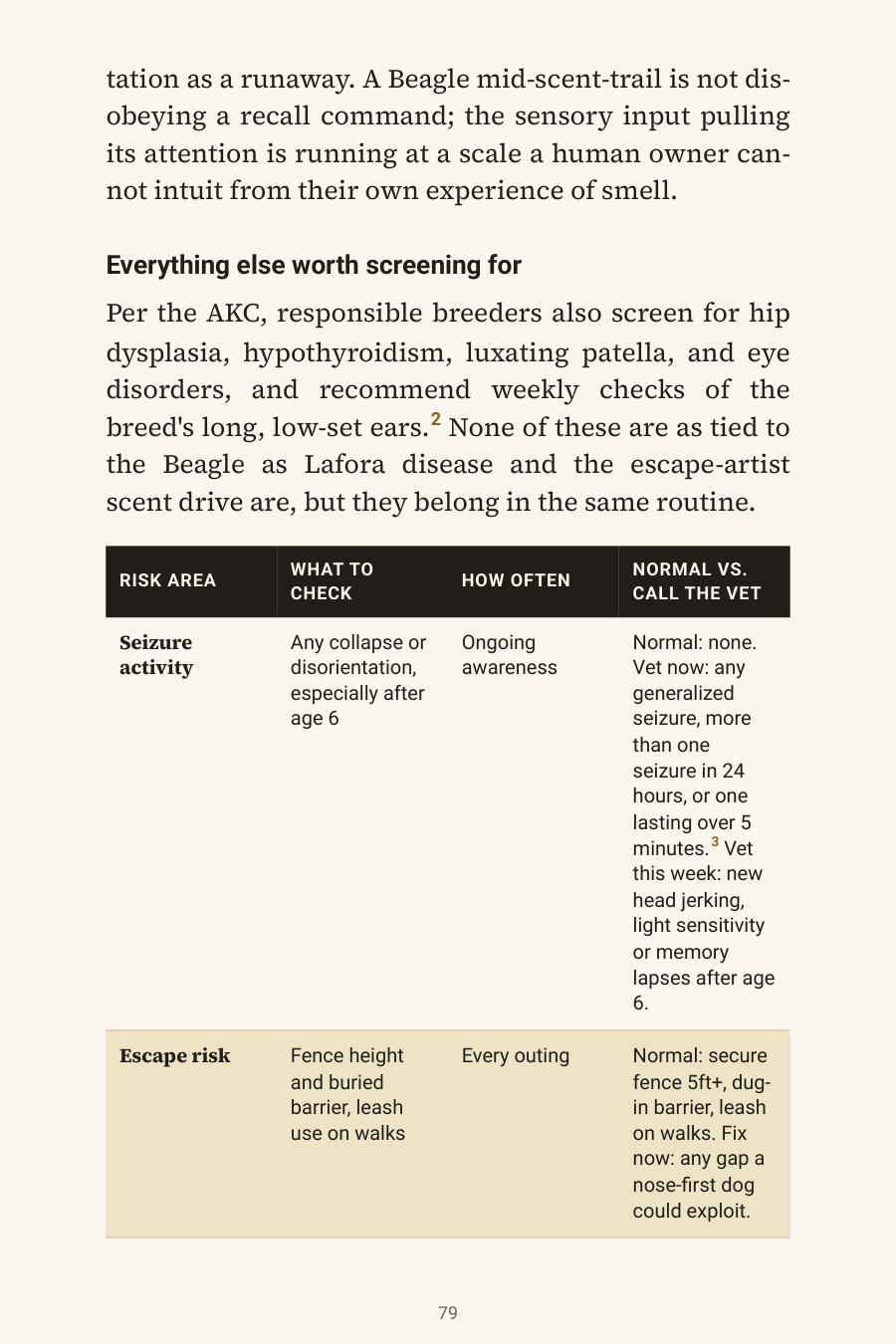
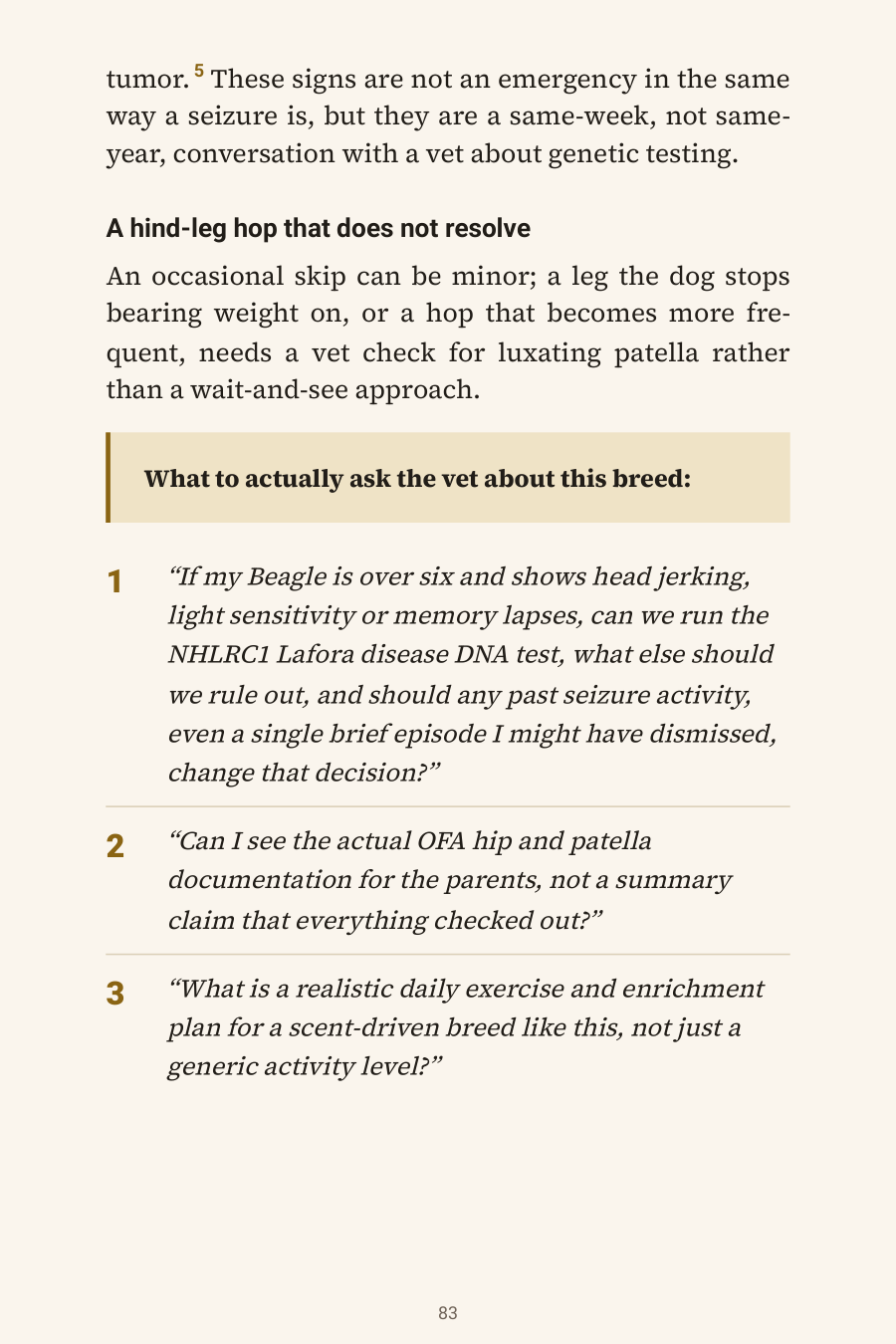
Open either page to read it full size.
The check frequencies and thresholds in the routine tables are this book's own suggestions rather than study results.
Where the figures come from
Each study, prevalence and cost figure is numbered to a source. All 115 sources are labeled by type, for example Official breed organization, Peer-reviewed study or Insurance company data (live page).
Page 3 of the book says: "Every specific figure in this book cites its source: a numbered note in the text points to the Sources page at the end of the chapter, where the source is listed with a source-type label. Where this book adds up cited figures or converts them to monthly or yearly amounts, it says so and cites them. The check frequencies and thresholds in the routine tables are this book's own suggestions rather than study results, and the summary table near the front repeats figures cited in each breed's chapter."
Where a source could not be confirmed independently, the book says so.
The free breed pages
The free breed pages on this site have no routine table and no list of breed-specific vet questions. The book itself describes the free pages as "the five-minute version" of a breed's genetic risk profile. If the free page for your breed already answers your question, you may not need the book.
Who it is for, and who it is not for
This is for you if you own one of the ten breeds in this book, or are planning to get one.
This is not for you if:
- Your dog is a mixed breed, or a breed that is not one of the ten.
- You want help choosing a breed. It is not a breed selector.
- You want a diagnosis or a treatment plan. It is not veterinary advice and does not replace a consultation with a licensed veterinarian.
- You want sheets you can type into. It is a PDF with no fillable fields.
- You need a full first-year cost breakdown for a Poodle, a German Shorthaired Pointer or a Bulldog. The Poodle and German Shorthaired Pointer chapters go milestone by milestone with no dollar figures, because no breed-specific costs from a named source could be found; the Bulldog chapter covers airway-surgery costs only.
One PDF, all ten breeds. There is no single-breed edition. Your breed's chapter runs 13 to 20 pages of the 159. The French Bulldog chapter, at 20 pages, is the longest.
$54.99. One PDF with no fillable fields.
Refunds
No refunds. All sales are final.
Because an ebook is a digital product delivered by instant download, we are unable to offer refunds once the file has been sent. There is no way to "return" a PDF the way you would a physical item.
If you have a technical problem (the file will not download, arrives corrupted, or you did not receive your download link), contact us at hello@breedverified.com and we will help you get a working copy of the file. Technical help does not include a refund.
Secure checkout on Gumroad. Instant PDF download after purchase.
It covers ten breeds only.
The Cat Breed Guide
A chapter for ten cat breeds: their real risks, their first-year costs, every source labeled.
If your cat is one of these ten breeds, it has a chapter of its own: Maine Coon, Ragdoll, Persian, Exotic Shorthair, Devon Rex, Abyssinian, British Shorthair, Siberian, American Shorthair and Russian Blue. The Cat Breed Guide puts all ten in one 111-page PDF.
The free breed pages on this site cover temperament, feeding and the questions people search most. They don't have a breed-specific warning-signs section or a first-year cost breakdown. The guide has both, for each of the ten breeds.
In your breed's chapter
- Genetics and health, specific to the breed.
- A Warning Signs section.
- The first year, with cost figures from named sources — except the Russian Blue, whose chapter starts from the general ASPCA baseline because this book didn't find a breed-specific condition worth adding to it.
- A short review at the end, before you turn the page.
- Its sources, each one labeled by type.
This book is provided for educational and informational purposes only. It is not veterinary advice and does not replace a diagnosis, a treatment plan, or a consultation with a licensed veterinarian. Always consult a veterinarian for decisions about your pet's health.
What it doesn't cover
If your cat isn't one of these ten breeds, the guide won't cover it. There's no print edition yet. Most of the 51 sources are official breed-organization pages, veterinary genetics labs and welfare-organization data; a smaller number are peer-reviewed studies.
Open your breed's chapter and take its review to your next vet visit.
One PDF, all ten breeds. There is no single-breed edition.
$54.99. One PDF file, all ten breeds.
Refunds
No refunds. All sales are final.
Because an ebook is a digital product delivered by instant download, we are unable to offer refunds once the file has been sent. There is no way to "return" a PDF the way you would a physical item.
If you have a technical problem (the file will not download, arrives corrupted, or you did not receive your download link), contact us at hello@breedverified.com and we will help you get a working copy of the file. Technical help does not include a refund.
Secure checkout on Gumroad. Instant PDF download after purchase.
It covers ten breeds only.